
K116 Payout Audit: Real Withdrawals or Red Flags?
The biggest question surrounding any online gaming platform with money-related features is not how attractive the interface looks. It is whether users can actually withdraw funds successfully when they become eligible to do so.
That is where a K116 payout audit becomes useful.
Instead of judging K116 only from promotional screenshots, referral posts, or claims made across social media, users should look at the actual withdrawal trail. A genuine payout assessment requires more than seeing a “Successful” message inside an account. The important question is whether the money reaches the user’s own payment account and whether the transaction can be independently confirmed.
This guide examines the K116 withdrawal process, payout evidence, JazzCash considerations, possible red flags, and practical safety checks. The goal is not to make an unsupported claim that K116 is either completely legitimate or fraudulent. The goal is to explain how users can assess a payout claim before putting more money into an account.
If you are researching the platform itself, you can review the current information available on the K116 Game website.
K116 Payout: What Are We Actually Checking?
A payout audit is different from a normal K116 review.
A normal review may discuss the interface, registration, games, bonuses, or general account features. A payout audit focuses specifically on the movement of money.
For K116, the important questions include:
- Can an eligible user submit a withdrawal request?
- Is the withdrawal recorded inside the account?
- Is a transaction or reference number generated?
- Does the status change after submission?
- Does the requested amount actually reach the recipient?
- Are fees clearly explained?
- Does the payment arrive through the selected method?
- Are users asked for additional money before receiving a withdrawal?
These questions provide much stronger evidence than a promotional statement.
A platform may advertise withdrawals, but advertising a payment feature is not the same thing as independently proving that every withdrawal will succeed.
How a K116 Withdrawal Should Be Evaluated
The easiest way to assess a K116 withdrawal is to separate the process into several stages.
Withdrawal Request
The user enters the amount and selects an available withdrawal method.
At this stage, record the requested amount and date.
Platform Processing
The K116 account may show a status such as pending, processing, successful, rejected, or another equivalent status.
This is an internal platform record.
External Payment
The most important stage is whether the money actually appears in the user’s external payment account.
For example, if JazzCash is selected and the withdrawal is supposedly completed, the user should independently check the JazzCash account.
Transaction Confirmation
Save the payment notification, transaction reference, account history, or other available evidence.
This creates a basic audit trail.
The difference between K116 says successful and “the money is independently visible in my payment account” is important.
K116 Real or Fake? Don’t Judge It From One Screenshot
Screenshots can be useful, but they are weak evidence when considered alone.
A screenshot might show:
Withdrawal Successful
But the image may not establish:
- Who received the money.
- When the money arrived.
- Whether the transaction was genuine.
- Whether the screenshot belongs to the person publishing it.
- Whether the same result occurs for other users.
- Whether the withdrawal was later reversed.
A stronger evidence set connects the entire transaction:
K116 request → K116 transaction record → payment reference → recipient account → actual received amount
Even one successful transaction should not be treated as proof that every future withdrawal will work. Repeated evidence from independent users is considerably more useful.
K116 Withdrawal and JazzCash: What Users Should Know
JazzCash is a separate financial service from K116.
This distinction matters because seeing the JazzCash name or logo on a third-party gaming platform does not, by itself, prove that JazzCash endorses that platform.
JazzCash’s official website provides its own information about money transfers, wallet services, security, and customer support. Its official transfer information states that verified users can send and receive money and that transactions use security measures including MPIN authentication and, where applicable, OTP verification.
Therefore, if a K116 withdrawal is supposedly sent to JazzCash, the user’s own JazzCash account should be the independent reference point for checking whether the money actually arrived.
For official JazzCash information, use JazzCash’s official website.
How to Check a K116 JazzCash Withdrawal
If JazzCash is available as a withdrawal option, users should avoid relying exclusively on the K116 dashboard.
Instead, follow a simple evidence process:
- Record the K116 withdrawal amount.
- Save the withdrawal request details.
- Note the date and approximate time.
- Record any transaction or reference number.
- Wait for the platform’s stated processing period.
- Check the JazzCash account independently.
- Compare the amount received with the amount requested.
- Save the completed transaction record.
If the K116 account says a withdrawal has been completed but there is no corresponding payment in the recipient’s JazzCash account, do not immediately assume the money is coming later.
Investigate the transaction through the appropriate official support channels.
K116 Payout Red Flag: Extra Deposit Requests
One of the most important warning signs is an unexpected demand for additional money before a withdrawal can supposedly be released.
For example, a person may claim:
- “Deposit more money to unlock your withdrawal.”
- “Pay a verification fee first.”
- “Add funds before your account can be approved.”
- “Send money to this agent to release the payout.”
- “Pay a security amount before withdrawal.”
Users should stop and verify the situation before sending additional funds.
A legitimate fee, if one exists, should be clearly described in the platform’s official terms or withdrawal information. A random person demanding money through WhatsApp or another private channel is a different situation.
Do not confuse a support message with proof of legitimacy.
K116 Red Flag: Fake Customer Support
Impersonation is another major risk.
Someone may contact a user after seeing a withdrawal complaint and claim to be K116 support. They may ask for account credentials, payment information, OTP codes, or other sensitive details.
The same principle applies to JazzCash.
JazzCash explicitly states that it will never ask for a customer’s PIN, OTP, or password and advises customers to report suspicious calls or messages.
Therefore, never give your JazzCash MPIN, OTP, or password to someone claiming that it is necessary to release a K116 withdrawal.
If somebody asks for sensitive authentication information, stop the conversation and use an official support channel instead.
K116 Withdrawal Red Flag: Endless Pending Status
A pending withdrawal does not automatically prove that K116 is fake.
Payments can experience delays for several reasons, including account checks, processing issues, technical problems, payment-provider issues, or platform procedures.
The concern becomes stronger when:
- There is no meaningful status update.
- Support stops responding.
- The withdrawal repeatedly gets rejected without explanation.
- New deposits are demanded to process an old withdrawal.
- Different explanations are provided by different support agents.
Users should document the original withdrawal instead of repeatedly sending more money.
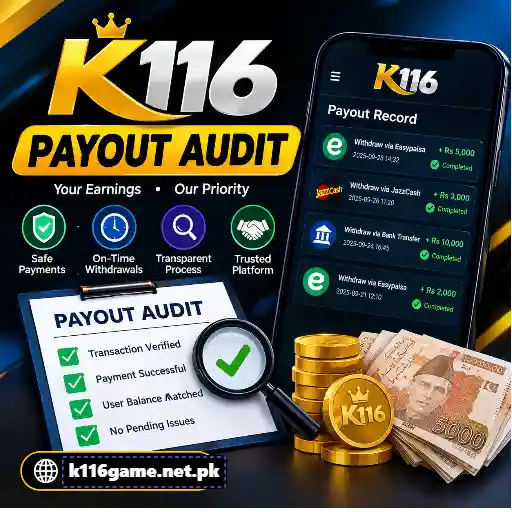
K116 Payout Audit: What Evidence Is Strongest?
Not all evidence has the same value.
Here is a practical hierarchy:
| Evidence | Strength |
|---|---|
| Promotional claim | Low |
| Anonymous screenshot | Low |
| Social media testimonial | Low to moderate |
| K116 account withdrawal status | Moderate |
| Transaction/reference record | Stronger |
| Independent payment-account record | Strong |
| Multiple independently documented transactions | Strongest |
This does not mean screenshots are useless. They can help establish a timeline. They simply should not be treated as conclusive evidence on their own.
K116 Payment Amount vs. Amount Received
Another important part of a payout audit is comparing the requested amount with the amount actually received.
For example:
Requested: PKR 1,000
Received: PKR 1,000
That is straightforward if no fee applies.
But if the user requests PKR 1,000 and receives PKR 850, there should be a clear explanation for the difference.
Possible reasons could include a disclosed service charge or another documented condition. The user should not have to guess.
Before requesting a withdrawal, check the current platform rules for:
- Minimum withdrawal.
- Maximum withdrawal.
- Fees.
- Eligibility.
- Verification requirements.
- Processing conditions.
- Bonus-related restrictions.
These conditions can change, so users should check the current information rather than relying on an old blog post.
Why a Successful Deposit Does Not Prove a Successful Withdrawal
A common mistake is assuming:
“My deposit worked, so the platform must be reliable.”
That conclusion is too broad.
Deposits and withdrawals are separate processes.
A platform can accept an incoming payment successfully while a withdrawal may have different conditions, processing requirements, or limitations.
Therefore, a serious K116 review should evaluate both sides of the transaction.
A successful deposit demonstrates that money entered the platform.
A successful withdrawal demonstrates that money left the platform and reached the intended recipient.
For a payout audit, the second test is particularly important.
K116 Payout Safety Checklist
Before using a K116 withdrawal feature, check the following:
- Withdrawal rules: Are the conditions clearly explained?
- Minimum amount: Is the minimum withdrawal stated?
- Fees: Are deductions disclosed?
- Payment method: Is the selected method currently available?
- Account ownership: Is the payment account yours?
- Transaction ID: Is there a reference number?
- Processing status: Can you monitor the request?
- Support: Is there an official support channel?
- Security: Is anyone requesting your OTP or MPIN?
- Evidence: Are you keeping transaction records?
This checklist is simple, but it can prevent many avoidable mistakes.
How JazzCash Users Can Protect Their Accounts
If you use JazzCash for any online transaction, account security should remain separate from the gaming platform itself.
JazzCash’s official customer-contact page states that it will never ask for your PIN, OTP, or password. It also provides official channels for complaints and suspicious activity.
JazzCash’s terms also advise customers to contact the service promptly if they believe their account has been accessed without authorization or their MPIN has been misused.
Therefore:
Never share your MPIN.
Never share an OTP with an unknown person.
Never give your password to someone claiming to process a withdrawal.
Never install remote-control software simply because an online agent tells you to.
These precautions apply regardless of whether the underlying K116 transaction is successful or unsuccessful.
K116 Withdrawal Problems: What Should You Record?
If something goes wrong, documentation becomes important.
Create a simple record containing:
- K116 username or account identifier, without sharing passwords.
- Withdrawal amount.
- Date and time.
- Payment method.
- Transaction ID.
- Screenshot of the withdrawal status.
- Payment notification, if received.
- Amount actually received.
- Support conversation.
- Any fee or additional-payment request.
Do not publish sensitive information publicly.
Blur phone numbers, CNIC details, account numbers, OTPs, MPINs, and other private information before sharing screenshots online.
Is K116 Payout Real or a Red Flag?
The answer should depend on evidence rather than marketing.
If a user can repeatedly document withdrawals from K116 to their own payment account, those transactions provide meaningful evidence that payouts can occur under those particular circumstances.
However, isolated screenshots or promotional statements are not enough to establish universal reliability.
Likewise, a delayed withdrawal is not automatically proof of fraud.
The stronger warning signs are patterns such as unexplained extra deposits, requests for sensitive payment credentials, misleading support identities, repeated unexplained withdrawal failures, or inconsistent explanations.
K116 Payout Audit Verdict for 2026
The most responsible verdict is evidence-based rather than promotional.
K116 payout claims should be treated as something to verify through actual transaction records. Users should not assume that a successful status inside a gaming account automatically means money has reached their wallet.
The safest method is to track the entire transaction from the withdrawal request through to the external payment account.
If JazzCash is used, verify the result directly through the user’s own JazzCash account and follow JazzCash’s official security guidance. JazzCash provides official customer-support and complaint channels for account and transaction issues.
The central lesson from this K116 payout audit is simple:
A screenshot can show a claim. A verified transaction can show evidence.
Users should rely on the second one.
Frequently Asked Questions About K116 Payouts
Is K116 payout real?
A payout claim should be evaluated through actual transaction evidence rather than promotional screenshots. A completed withdrawal that can be independently confirmed in the recipient’s payment account is stronger evidence than an internal “successful” message.
Does K116 support JazzCash withdrawal?
If JazzCash is currently displayed as an available withdrawal method on the K116 platform, users should follow the current instructions shown in their account. Payment-method availability can change, so verify it before submitting a transaction.
How can I check a K116 withdrawal?
Record the requested amount, withdrawal date, status, and transaction reference. Then independently check the destination payment account to confirm whether the money was actually received.
Is a K116 withdrawal screenshot proof of payment?
No. A screenshot can support a claim but does not independently establish that the money reached the recipient. A corresponding transaction record is stronger evidence.
What should I do if my K116 withdrawal is pending?
Check the withdrawal status and the platform’s stated processing conditions. Keep your transaction information and use the official support channel if the delay exceeds the stated timeframe. Do not send additional money to an unknown person simply because they promise to release the withdrawal.
Can someone ask for my JazzCash OTP for a K116 withdrawal?
You should never provide your JazzCash OTP to an unknown person. JazzCash states that it will never ask customers for their PIN, OTP, or password.
Does using JazzCash prove that K116 is legitimate?
No. JazzCash is a payment service, while K116 is a separate platform. The presence of a JazzCash payment option does not independently prove that K116 is endorsed or guaranteed by JazzCash.
What is the biggest K116 payout red flag?
An unexpected demand to send additional money before an existing withdrawal can be released is a significant warning sign. Users should stop and verify the requirement through official information before sending anything.
Should I keep K116 withdrawal records?
Yes. Keeping withdrawal requests, transaction references, payment notifications, and final received amounts makes it easier to investigate discrepancies.
What is the safest way to evaluate K116 Payout Audit?
Start with a small amount you can afford to lose, understand the current withdrawal rules, document the transaction, verify the payment independently, and never share your financial authentication credentials.
Final Takeaway
A proper K116 payout audit should focus on evidence rather than excitement.
The strongest approach is to verify the complete payment trail, compare the requested and received amounts, understand withdrawal conditions, and watch for unusual requests for additional deposits or sensitive account information.
For JazzCash users, the payment account should be checked independently, and official JazzCash security guidance should always take priority over instructions received through random messages or unofficial support accounts.
If you are researching K116 before using it, the best question is not simply “Is K116 real or fake?”
Ask a more useful question:
Can the specific payout I am evaluating be independently verified?
That is the standard that provides a much clearer picture of any online platform’s withdrawal claims.